In order to fully understand the relationship between Mahayana Buddhism and my community, I must first define my community. So far, I have scratched the surface of defining my community through anecdotal examples of specific qualities such as busy or stressful lifestyles. I have painted only a few strokes in what is the canvas of my community. During my research project, I have been trying to complete this painting, and now I will share my progress.
I chose to analyze my community through a materialist perspective, which is a perspective concerned with the day to day lifestyles of the working class. In feudal times, a materialist analysis of history would detail the lives of serfs working under nobles, listing everything from the tools they used to the amount of time they slept each night. Instead of focusing entirely on the feudal lords, a materialist historian would argue that detailing the lives of the serfs, the majority of the people living at any given estate or plot of land, paints a truer picture of life at that time. Thus, I want to detail the lifestyles of my community members as accurately as possible, focusing directly on the individuals and how they live their lives on a day to day basis. Considering that Mahayana Buddhism in my community is a belief system implemented by individuals on a personal level, and that the effects and implementations of Buddhism are best seen in day-to-day life, I think that this is a very relevant perspective to use for my research project.
What "objects" or "matter"do Buddhists in my community own and value? How does their world feel and look? Do Scottsdalian Buddhists structure their lives to flow seamlessly between the working world and the spiritual one? This is the lens through which I have chosen to analyze my community. In my next posts, when I dive deeper into what truly constitutes the lives of Buddhists in Scottsdale and Phoenix in 2013, you will now know where I am coming from.
Namaste!
Sunday, April 28, 2013

Thursday, April 18, 2013
Buddhism's Adaptability to Western Lifestyles
I live in a Western culture with a mainly Judeo-Christian religious background. Because Buddhism is an Eastern tradition, it may seem improbable for Buddhism to successfully adapt to exist in this Western culture. However, as I have learned throughout my research project, there is a strong Buddhist community in my Valley area. The ability of Buddhism to successfully adapt to this Western culture can be largely attributed to Buddhism's flexibility for incorporating the belief system into already established lifestyles. For example, 4 out of the 10 active Buddhist community members I questioned claim to incorporate Buddhism simultaneously with other religions, from Christianity to Judaism to Hinduism. This brings to mind a teaching I heard from the Rinpoche at the Emaho Foundation: believe only what you see with your eyes, what you yourself reason to be true. This teaches Buddhist practitioners to be skeptical along whatever road they choose to walk down, whether it is one seeking spiritual answers or pragmatic approaches to dealing with the stresses of life. Because Buddhism does not tell its students to believe something as inherently true, these students are not forced to accept a pre-mandated set of beliefs or spiritual premises. This freedom to believe ideas or teachings based on your own reasoning allows Buddhist community members to take what they like, and leave what they don't. Therefore, a Christian who inherently believes in the birth of Jesus Christ is not necessarily contradicting any other Buddhist teachings or messages. This freedom can extend beyond the religious sphere into politics or other institutionalized beliefs related to the family or certain aspects of the community. The Emaho Foundation hosts liberals, conservatives, married couples, single parents, straight people, homosexuals, Mexicans, African-Americans, Caucasians, and more. Because Buddhism does not inherently exclude any type of individual, the belief system naturally attracts people from all socioeconomic backgrounds.
Naturally, individuals with an already established cultural identity may be unlikely to embrace different lifestyle additions or ways of thinking. A Christian who is satisfied with his spiritual development and practice may find no need for any additional teachings or perspectives-- and that is fine. However, if individuals do choose to look elsewhere for answers (whatever answers those may be), Buddhism does not force them to alter any ingrained quality or belief. Because of this, Buddhism is easily adaptable at whatever degree the practitioner chooses.
 |
Saturday, March 23, 2013
Scottsdale, Phoenix, and Mahayana Buddhism
Although I am still young, for most of my life, I have always been busy. I would wake up, go to school, go to soccer practice, study and do homework, and then, if lucky, sleep. I have spoken with many adults who have a similarly demanding lifestyle. Work occupies the majority of their day, not to mention family obligations, grocery shopping, long hours of checking emails, and maybe some much needed personal time like catching a movie or taking yourself out to dinner. Either way, the modern lifestyle in Scottsdale and Phoenix can be far from easygoing.
 |
| Buddhism? Who has the time for that?! |
Because the Scottsdale-Phoenix lifestyle can be so hectic, it would make sense to think that practicing Buddhism is improbable and impractical. Who has time to practice or explore Buddhism in addition to everything else going on in life?
In Mahayana Buddhism, there are many ways to practice. There is sitting meditation, chanting mantras, reading teachings, visualizing positive ideas, and more. These are activities that are guided 100% towards Buddhism, and that when practicing, leave no time for anything else (it is pretty hard to chant mantras while talking on the phone). For convenience purposes, let us call this type of Buddhist practice "Type 1. "
 |
| "Type 1" Buddhist Practice |
"Type 2" Buddhist practice, if you still allow me to denote my own classifications, is what makes Mahayana Buddhism applicable to Scottsdale and Phoenix. In this type of Buddhist practice, you can practice Buddhism 24/7, no matter what you are doing. This practice consists of focusing on mindfulness and the Bodhisattva lifestyle. Mindfulness is the act of being aware of the mind. This means watching your feelings, thoughts, emotions, and everything else that the mind seems to be involved with. It means watching why this makes you happy and why this makes you nervous, and why you want to do this at this time and that at that time. By being aware of your mind, you are still meditating, yet without entering full lotus position. You can practice mindfulness while working, driving, eating, and even while talking on the phone. Being mindful combines with the Bodhisattva lifestyle to create an extremely powerful Buddhist practice that is applicable anywhere, anytime. As I mentioned earlier, the Bodhisattva lifestyle is a way of life taught directly by the historical Buddha. The Buddha said that when practicing the Bodhisattva attitude, you are practicing with the most powerful method available in Buddhism (in my previous post, you will notice that this is Mahayana Buddhism's interpretation on teachings of the Buddha). The Bodhisattva lifestyle is the lifestyle dedicated to the well-being of all living beings. This means that if you are practicing the Bodhisattva way of life, your primary concern is the well-being of others; you are dedicated to creating happiness and eliminating suffering. This is accomplished by generating love, kindness, compassion, understanding, patience, and more for all living beings. When mindfulness combines with this Bodhisattva attitude, your practice still enforces the benefits and ideas of "Type 1" practice, so you are not necessarily losing anything by forgoing seated meditation or mantra chanting. There is never a time when you cannot try to be aware of your mind, and when you cannot try to generate loving compassion for those around you. This is the attitude taught at the Emaho Foundation, and this is the same attitude that allows the citizens of Scottsdale and Phoenix to participate in Buddhism without abandoning their busy lifestyle. "Type 2" Buddhist practice is a feature of Mahayana Buddhism that allows Buddhist practice to flourish at whatever level the practitioner wishes. You may notice that combining mindfulness with a Bodhisattva attitude is not necessarily spiritual in any way-- it is simply the act of focusing on kindness while being aware of yourself. This is one pillar of Buddhism that holds strong the Buddhist community of Scottsdale and Phoenix.
Friday, March 22, 2013
Mahayana Buddhism
Just like ice cream, Buddhism has many different flavors and varieties. However, despite the numerous strains that exist throughout the world, these varieties can be condensed into two main branches of Buddhism: Mahayana and Theravada. Both traditions ultimately blossom from the teachings of the historical Buddha (Shakyamuni Buddha, Prince Siddhartha), and thus they share similar goals and motives. To better understand these two schools of Buddhism, think of them as different expressions of the same teaching. Both types of Buddhism ultimately strive to eliminate suffering and the causes of suffering, as this was the Buddha's main objective when spreading his teachings.
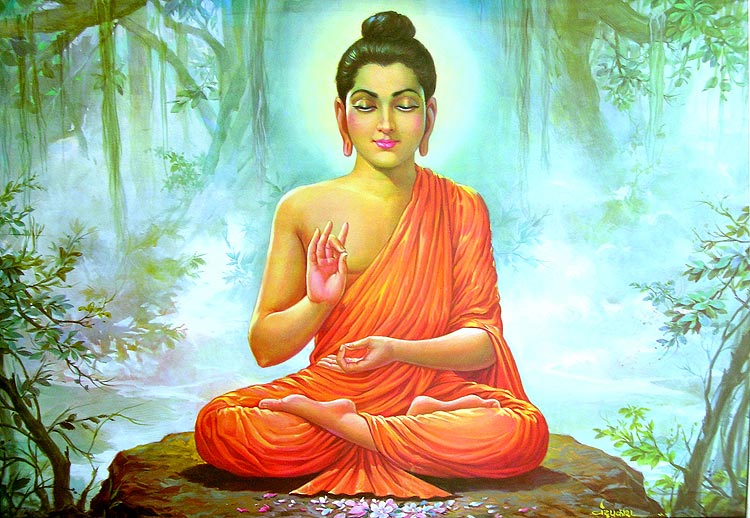 |
| The Historical Buddha |
The differences arise in method and literature. As for literature, the Theravada tradition relies on teachings recorded in the Pali language, while the Mahayana tradition relies on teachings recorded in Sanskrit. Although these teachings essentially spread the same message (a means to be free from suffering, understanding suffering, etc.), that message can have different interpretations, which is how the two schools come to differ in method. The Mahayana tradition highly emphasizes the bodhisattva path as the most powerful method for reaching enlightenment (freedom from suffering and the causes of suffering). The bodhisattva path, in a nutshell, is the lifestyle that is dedicated to helping all other beings. The happiness of all others is the main concern of the bodhisattva, and bodhisattvas try to cultivate this happiness through compassion, a positive mindset, understanding, and more. The Theravada school of Buddhism does not emphasize the bodhisattva path as essentially as in the Mahayana tradition, but instead focuses more on meditations to cultivate wisdom and insight.
The Emaho Foundation follows in the Mahayana tradition, along with North Asian countries such as Tibet, China, Taiwan, Japan, Korea, and Mongolia. The Theravada tradition has followers in Southern Asia, for example Sri Lanka, Thailand, Laos, and Cambodia. Understanding the Mahayana tradition is a crucial aspect of my research project, for I am studying the nature of the Mahayana tradition and how it applies in the local community in which I live. There are many extensive works written on the differences between various forms of Buddhism, and this blog post is just a tid-bit of the vast information available.
Saturday, March 9, 2013
Our Own Buddha Nature
When you think of the word "Buddha," you are most likely thinking of Shakyamuni Buddha, otherwise known as Prince Siddhartha. Shakyamuni Buddha is the historical Buddha, the Buddha that serves as a role model for Buddhist teachings. Shakyamuni Buddha embodies the qualities of compassion, fearlessness, thoughtfulness, and nearly every other quality that is promoted in Buddhism. Because of this, students of Buddhism are taught to respect this Buddha, similar to a high school quarterback respecting Peyton Manning for his passing ability or throwing technique.
 |
| Shakyamuni Buddha |
In the Lam-Rim teachings taught by ZaChoeje Rinpoche, Rinpoche tells his listeners that by respecting these admirable qualities in the Buddha, we are respecting these same qualities in ourselves. When we admire Shakyamuni Buddha for his happiness, we are admiring our own ability to be happy. By respecting the Buddha as a role model, you begin to define what you wish to achieve and generate for yourself, whether it is happiness, patience, compassion, etc. I was often told to be wary of those I associate myself with, for one way or another, their influence will rub off on me. In other words, this is the idea that associations in life will influence your thoughts, actions, and behavior, either in a direct or indirect manner. Self-Help books claim that to be successful, you must surround yourself with successful people. Down a similar avenue, when you consciously admire Shakyamuni Buddha for being compassionate, you are creating an association (albeit, a mental, intangible one) that lets yourself know you respect compassion. "Compassion is something good," you tell yourself. Modern celebrities are often criticized for being a little too sexual, unintelligent, vulgar, or crude. These criticisms bear relevance because in some cases, these celebrities are the same people that the youth view as role models, and nobody wants the qualities of being unintelligent or vulgar to rub off on them. Just as a crude, drug-abusing celebrity can have negative influences as a role model, a compassionate, loving Shakyamuni Buddha can have positive influences. Thus, by respecting the Buddha-like nature of Shakyamuni Buddha, we respect the Buddha-like nature of ourselves.
Saturday, February 23, 2013
Staying Centered
Life is not always easy. Each day, there are constant struggles that have the potential to weigh people down. Days can be filled with obligations for work and family, stress related to physical appearance and social life, etc. It is difficult to stay positive throughout an entire day when confronted with a busy and demanding schedule.


Daily Struggles
The last time I visited the Emaho Foundation, I was fortunate enough to speak with 4 active Buddhist community members. I asked them why they involve themselves with Buddhism, and what they take out of it. Although each individual may focus on different aspects of Buddhism as they delve deeper into the thought system, there is one common denominator shared by all. All 4 individuals say that they use Buddhism to center themselves throughout the day.
 |
| Ahhhhhh... |
The first individual said that she "struggles with negativity, overcoming emotions, [and being] mentally scattered," throughout the day. Meditation and mindfulness (mental awareness, noticing how your mind reacts to different stimuli) help this individual stay centered throughout the day, so as to not be weighed down by the burdens of daily life. The second individual, Joanne Goodwin, recognizes hateful emotions and negativity in her daily life, so she uses "Love and Compassion as the perfect antidote." Further illustrating her point, she tells me, "Someone could cut me off while I'm driving. But instead of getting all mad [makes an angry face to imitate roadrage], I realize that the person isn't trying to make me angry, that he feels the same emotions I do, and that kindness is what I should focus on." If only every driver thought like that! The third individual I questioned said that she incorporates mindfulness as much as she can throughout the day. Whether she is feeding her pets, doing laundry, etc, she tries to stay mentally aware of her thoughts and emotions as a technique to stay centered and grounded. The fourth individual, Gabriella Ciuca, views Buddhism as a "science of the mind." By exploring this science, Gabriella becomes aware of what affects her mind, and then centers herself with greater ease and peace. All four individuals I interviewed have many different thoughts and experiences with Buddhism; yet, when it comes to using Buddhism as a daily tool to center the mind, all four are alike.
Friday, February 22, 2013
Shaping Your Container
To all of my student readers (adults can sympathize too), how unbearable are those last five minutes of class when seconds seem like minutes and minutes seem like eternity? There are times when an entire school day can seem that painful, maybe because there is a party after school, or maybe because you can't stop thinking about where you are going for dinner. Sometimes, the brain cares more about what clothes will be worn tonight at Ricky's house, and less about why a certain metaphor is really symbolic of the entire novel, or why a certain verb is irregular in the past tense. The motivation of the student is the most important determinant for how meaningful lectures or classes will become. We have all heard the phrase, "It is difficult to help someone who does not want to be helped," and this tidbit of wisdom is as applicable to school as it is to Buddhism.
 |
| This student is NOT ready to learn... |
Today, I had the wonderful opportunity of listening to the Rinpoche teach the essence of the Lam Rim teachings at the Emaho Foundation. Before the Rinpoche taught us, however, he received these same teachings himself from another very respected monk-- the Dalai Lama. These teachings are very important in Buddhism, and in order to ensure that those listening make the most of the lecture, Buddhism employs "Preliminary Practice", a technique engineered to prevent the mindset in the image above.
The idea of preliminary practice is to generate the motivation and frame of mind that is conducive to full attention and eager learning. The idea is to create a mindset that every teacher desperately prays will manifest in one of her students. However, in the words of the Rinpoche, the idea is about "Shaping your Container." This container will eventually hold all of the meaning and understanding of the lecture, but first it must be created. Yet this cannot be any old container lying around the house. This container must be clean, for any bacteria or stains will only contaminate the teachings. This container must be strong and whole, for a crack is only another way for wisdom to seep out and forever be lost.
 |
| A worthy container |
From the mouth of the Rinpoche flows the water of his teachings, and if we cannot contain this water, we may as well not show up in the first place. We are taught to shape our container through meditation, chanting words of motivation, and discussing the purpose of attending the lecture in the first place. By the end of this practice, I was amazed to discover that it lasted 1 and 1/2 hours! That was just preparation for the essential teaching I thought would start right away. However, shaping my container was well worth the effort. By the time my container was shaped, every morsel (to the best of my ability) of my mind was focused on the teachings soon to come. Shaping my container made me realize that it is very silly not to devote my mind 100% to the teaching, for otherwise, what is the point of even showing up? If my mind is going to daydream about playing soccer, for example, I may as well be on the soccer field-- not half-listening to a teaching that I won't remember. This preliminary practice relates to Buddhism's overarching theme of controlling and being aware of the mind. Awareness of the mind seems to apply to everything in Buddhism, from realizing why you experience different emotions to generating a mindset that prepares you for learning.
Subscribe to:
Posts (Atom)